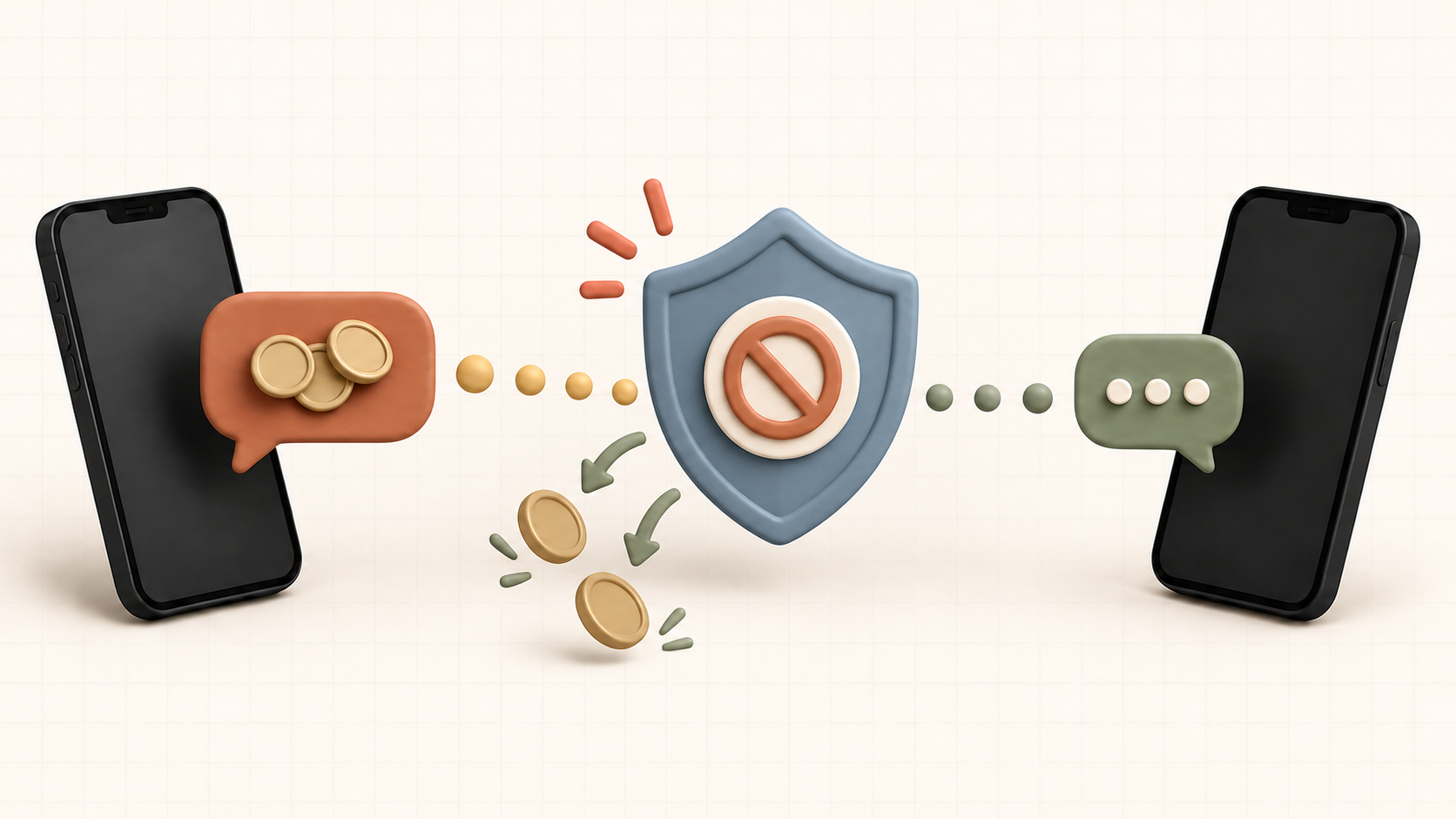
When an online friend asks for money, the safest response is to pause and not send anything. A genuine friendship can still involve a real emergency, but you cannot reliably confirm a person's identity, circumstances, or intentions from messages alone.
The request may arrive after weeks or months of ordinary conversation. That history can make saying no feel cruel. It does not make a financial request safe.
The short answer: Do not send money, gift-card numbers, cryptocurrency, banking information, account access, or a payment on someone else's behalf. Save the messages, check the story independently, and talk to someone you trust before doing anything else.
The Federal Trade Commission warns that a new online friend who eventually asks for money is probably running a scam, especially when they request a wire transfer, gift card, payment app, or cryptocurrency. Its guidance is to stop contact, report the account to the platform, and report the scam. You can read the FTC's warning about online friends asking for money.
Why a money request from an online friend is high risk
Online friendships can be genuine. The risk comes from the gap between knowing someone's messages and being able to verify their real-world identity and situation.
A scammer can maintain a believable profile, remember personal details, join voice or video calls, and spend a long time building trust. An account belonging to a real friend can also be hacked or impersonated. Neither familiarity nor a call proves that a payment request is legitimate.
Money changes the relationship too. Once you send it, emotional pressure may make it harder to refuse the next request or question the original story. That is why it helps to use a simple rule before an emergency appears: online friendships do not involve sending money or moving funds.
10 red flags when an online friend asks for money
One sign alone may not explain the whole situation, but you do not need to prove fraud before protecting yourself. The request itself is enough reason to pause.
1. The friendship became intense unusually quickly
The person may describe you as their closest or only trustworthy friend soon after meeting. They might message constantly, mirror your interests, or share dramatic personal stories that create fast intimacy.
This can make a later request feel like a test of loyalty. Healthy trust usually grows through consistency and mutual respect, not urgency. Our guide to building trust in an online friendship explains why time and small, observable actions matter.
2. A sudden emergency has only one solution: your money
Common stories involve medical care, housing, food, travel, a lost phone, an account problem, customs fees, or a family crisis. The details may sound plausible and emotionally urgent.
The warning sign is not merely that something bad happened. It is the claim that you must provide money immediately and that no local friend, relative, employer, service, charity, or official organization can help.
3. They ask you to keep the request secret
They may say other people would not understand, feel embarrassed, or interfere. They might insist that discussing the request would betray their confidence.
Secrecy prevents a second person from noticing inconsistencies. A safe friend may value privacy, but they will not require you to make a financial decision alone.
4. They create urgency or a countdown
Watch for statements such as "I need it in the next hour," "This is my last chance," or "If you cared, you would not make me wait." Urgency reduces the time available to think, verify, or ask for advice.
Real emergencies can be time-sensitive. You can still refuse to make an irreversible decision under pressure. Slow the interaction down and step away from the chat.
5. They specify a difficult-to-reverse payment method
Gift-card codes, cryptocurrency, wire transfers, and some payment-app transactions can be difficult to recover. A person may claim these are the only methods available or coach you through the process.
Never send a gift-card number or PIN. Do not open a cryptocurrency account, visit a crypto ATM, or install a payment app because an online contact instructed you to do so.
6. They reject safer forms of assistance
You may offer to help them find a local service, official helpline, shelter, food program, or other nonfinancial resource. A scammer will often dismiss every option that does not result in a direct payment.
Do not pay a supposed hospital, landlord, courier, relative, or government office using contact details or links the person supplies. Those destinations can be part of the same story.
7. The story changes when you ask ordinary questions
Dates, locations, names, and reasons for the payment may shift. Documents may contain mismatched details, strange formatting, or information that cannot be confirmed independently.
Do not treat an identification card, invoice, screenshot, ticket, or video as proof by itself. Images and documents can be stolen, edited, or generated. Search the person's name and story with words such as "scam" or "complaint," and consider a reverse image search of profile photos.
8. They avoid independent verification
The person may agree to voice or video calls but refuse any check that they do not control. They may become angry when you suggest contacting an organization through its public website or independently listed number.
A live call can add context, but it does not prove every claim. Even your first voice call with an online friend should be treated as communication, not identity verification.
9. They ask you to receive, deposit, or forward money
Sometimes the request is framed as a favor rather than a loan: receive a transfer, deposit a check, open an account, buy cryptocurrency, accept a package, or forward part of a payment to someone else.
Do not participate. The original payment or check may be fraudulent, and moving the funds can leave you responsible for the loss or involve you in illegal activity. Never share banking credentials or let someone use your account.
10. One payment leads to another fee
After you send money, a new obstacle may appear: a release charge, tax, customs fee, verification deposit, travel change, legal bill, or minimum balance. The person promises repayment after this final payment, but the finish line keeps moving.
Stop immediately. Do not send more money in an attempt to recover what you already paid. People who promise to recover scam losses for an upfront fee may also be scammers.
What to do immediately
You do not need to accuse the person or conduct your own investigation. Take these steps instead:
- Do not pay or click their links. Do not download files or install an app they recommend.
- Pause the conversation. You can leave the chat without explaining while you think.
- Save useful evidence. Keep the username, profile URL, payment instructions, messages, email addresses, phone numbers, and transaction details. Do not preserve illegal content; report it through the appropriate channel.
- Check independently. Use contact information you find yourself, not a number or website supplied in the request.
- Tell someone you trust. Describe the request exactly, including any instruction to keep it secret.
- Secure your accounts. If you clicked a suspicious link or shared credentials, change affected passwords from a trusted device and enable multifactor authentication.
- Report and block. Report the profile and messages to the platform, then block further contact when appropriate.
If the person responds to your caution with threats, guilt, humiliation, or repeated contact, that behavior is additional evidence that stepping away is the right choice. Review other online friendship red flags if you are unsure whether the broader relationship is safe.
What can you say to an online friend asking for money?
Keep your response short. A long explanation gives someone more material to argue against.
A clear refusal
I do not send money or financial information to people I know online. I cannot help with this request.
When they say it is an emergency
I am sorry you are dealing with that. I cannot send money. Please contact a local service or someone you know in person.
When they ask for a gift card or cryptocurrency
I will not buy gift cards, send codes, or transfer cryptocurrency. Do not ask me again.
When they want to use your account
I do not receive or forward money for anyone, and I do not share access to my accounts.
When the pressure continues
I have answered. I am ending this conversation and will report further requests.
You are allowed to block without sending a final message. A boundary does not require agreement; see more examples in how to set boundaries in online friendships.
What if you believe the emergency is real?
Feeling concerned does not mean you must accept financial risk. You can listen, suggest established local resources, or encourage the person to contact someone they know offline. Avoid becoming the coordinator of their crisis.
Do not pay a third party they introduce, share your identity documents, co-sign anything, take out a loan, or give them access to an account. Do not travel to deliver money. A financial request should not accelerate an online friendship into an in-person meeting; use a separate safety plan before meeting an online friend in person.
Even if the person's identity and circumstances are real, you can say no. Friendship does not create a financial obligation.
What to do if you already sent money
Act quickly, but be cautious of anyone promising a guaranteed recovery.
- Contact the company you used to pay. Tell the bank, card issuer, wire-transfer company, payment app, gift-card issuer, cryptocurrency exchange, or ATM operator that the transaction resulted from fraud. Ask whether it can be stopped, reversed, or refunded.
- Keep records. Save receipts, transaction IDs, wallet addresses, account names, messages, and your reports.
- Protect exposed accounts. Change reused or compromised passwords, enable multifactor authentication, and review account activity.
- Respond to identity exposure. If you shared sensitive identifying information, follow the official recovery steps for your country. In the United States, IdentityTheft.gov provides a recovery plan.
- Report the account and scam. Use the platform's reporting tools. In the United States, report it at ReportFraud.ftc.gov. People elsewhere should contact their national fraud-reporting service and local financial provider.
- Tell a trusted person. Scammers rely on embarrassment to keep victims isolated. Being deceived does not make you foolish, and getting support can help you act faster.
The FTC provides payment-specific instructions in What To Do if You Were Scammed. Recovery is not guaranteed, but contacting the payment provider promptly gives you the best chance to learn which options remain.
Watch for a second scam
After a loss, someone may contact you claiming to be an investigator, lawyer, government representative, hacker, or recovery specialist. They may know details about the first payment and promise to retrieve it for a fee.
Do not pay upfront for recovery or share more financial information. Find the organization's official contact information yourself and verify any claim independently.
If you are under 18
Do not send money, payment details, gift-card codes, identification, or account access to an online contact. Stop responding and tell a trusted adult promptly, even if you already sent something or promised to keep the request secret.
If the person threatens to reveal private images, messages, or information unless you pay, do not negotiate or send more material. Preserve safe evidence, report the account, and involve a trusted adult or appropriate authority.
Our anonymous chat safety rules cover additional ways to limit the personal information available to someone you have just met.
Frequently asked questions
Is it always a scam when an online friend asks for money?
You may not be able to know with certainty. The request is still high risk, and you do not need proof of a scam to refuse. The safest policy is not to exchange money with people you only know online.
What if we have talked for years?
Time can make a friendship meaningful, but it does not verify a financial story. A long-standing account can also be compromised. Confirm any unusual request through a separate, trusted method and do not send money under pressure.
Can a video call prove the request is legitimate?
No. It may confirm that you are speaking to the person you recognize, but it cannot prove the emergency, destination of the money, or intention to repay.
Should I lend only a small amount?
A small first payment can test whether you are willing to pay and lead to larger requests. Do not send an amount simply because losing it seems manageable.
Should I confront the person with evidence?
You do not have to. Confrontation may lead to more manipulation or cause the account to disappear before you save relevant details. Preserve the information you need, report the account, and disengage.
Can I stay friends after refusing?
A genuine friend should respect your financial boundary. If they punish, threaten, shame, or abandon you because you did not pay, step back and prioritize your safety.
A request for money can feel personal, but your response should be practical: pause, do not pay, check independently, involve someone you trust, and report suspicious behavior. Protecting yourself is not a betrayal of friendship.