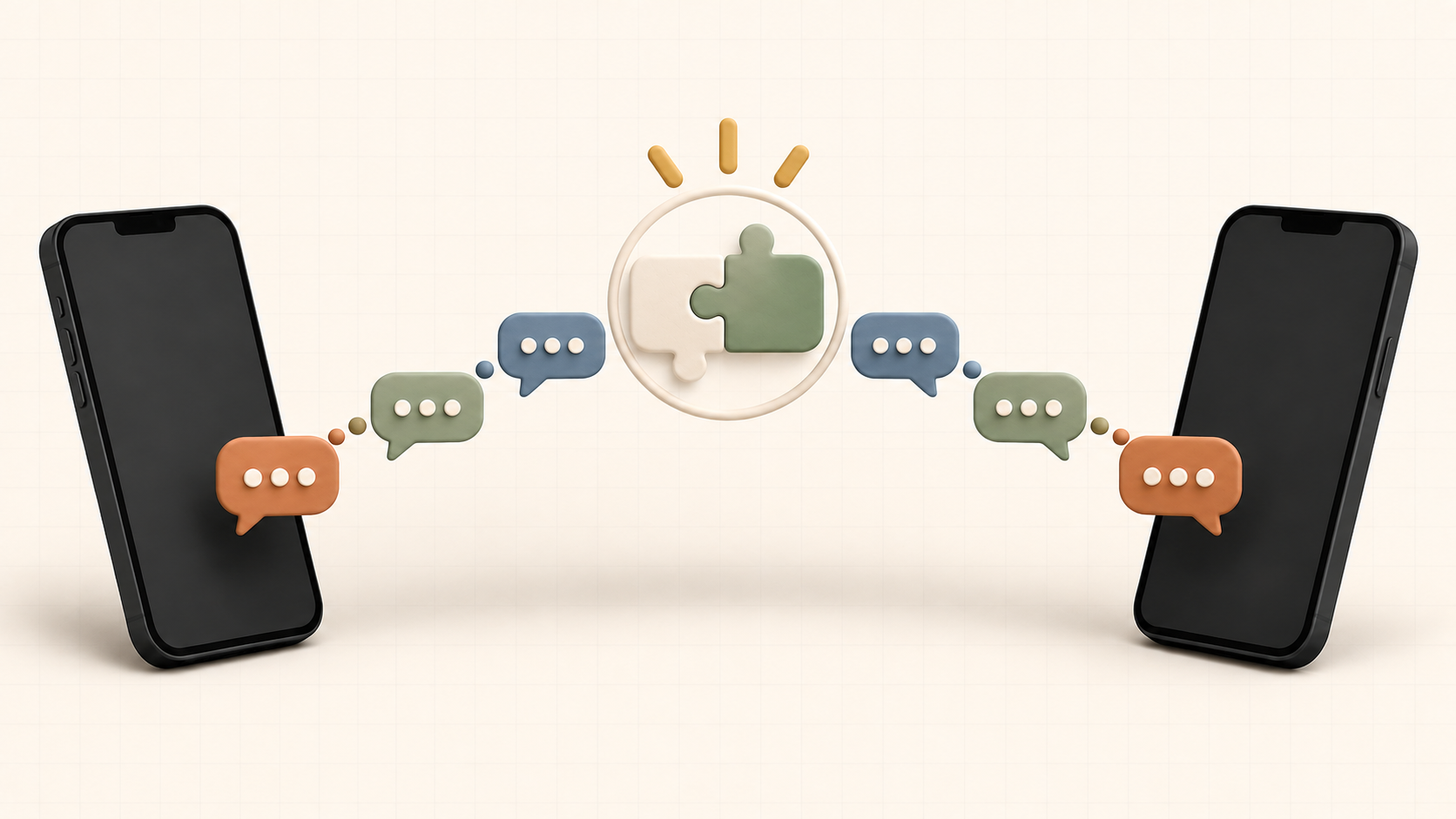
You can click with someone online in a single conversation. Trust takes longer.
A shared sense of humor, a thoughtful reply, or hours of easy conversation can create genuine chemistry, but chemistry tells you that an interaction feels good. Trust develops when a person's behavior remains respectful and dependable across time, ordinary moments, misunderstandings, and boundaries.
If you are wondering how to build trust in an online friendship, the safest approach is gradual. Start with low-risk interactions, notice patterns, and let access grow only when the relationship has earned it. The nine steps below can help without turning every new friend into a suspect or asking either person to surrender their privacy.
What Trust Means in an Online Friendship
Trust is reasonable confidence that someone will generally act consistently with what they say, respect your limits, and handle the access you give them with care.
It is not certainty. A profile, photo, voice call, or mutual group cannot prove everything about a person. Trust is also not the same as sharing secrets, talking every day, or moving the conversation to a more private app.
Healthy online trust has several parts:
- Reliability: They usually do what they say they will do.
- Respect: They accept your time, privacy, and consent boundaries.
- Honesty: Their important claims remain reasonably consistent.
- Reciprocity: Interest, support, and effort do not flow only one way.
- Repair: They can acknowledge mistakes and adjust their behavior.
- Safety: They do not use urgency, fear, guilt, or private information to control you.
No single warm conversation establishes all of these. Look for a pattern.
Chemistry Is Fast; Trust Is Evidence Over Time
Online conversations can become personal quickly because messaging removes some of the awkwardness of face-to-face interaction. You may also fill in missing information with optimistic assumptions. That is normal, but it is helpful to keep two questions separate:
- Do I enjoy talking with this person?
- Has this person shown that they are trustworthy with more access?
The answer to the first can be yes while the second is still "I do not know yet." You can appreciate a new connection without making immediate promises, sharing sensitive information, lending money, or rearranging your life around it.
1. Begin With Consistent, Low-Risk Conversation
Trust starts in ordinary exchanges. Talk about a shared interest, a game, a creative project, a book, or something happening in the community where you met. This gives you both a natural reason to interact without forcing personal disclosure.
Notice whether the conversation feels mutual:
- Do they ask questions and respond to your answers?
- Can they accept that you may reply later?
- Do they contribute instead of expecting you to carry every exchange?
- Are they broadly the same person from one conversation to the next?
You do not need to message constantly. In fact, a connection that remains comfortable through normal gaps can reveal more than an intense burst of nonstop contact.
If you are looking for a natural place to begin, read how to make friends online through shared interests.
2. Be Honest Without Sharing Everything
Trust grows when both people communicate honestly, but honesty does not require total access.
You can be truthful at the level of detail that feels safe. For example, you might share your general region instead of your address, describe your field instead of naming your employer, or say that a family issue is difficult without explaining every detail.
Avoid creating a false identity or inventing major life facts. If you use a nickname or keep details general for privacy, you can say so simply:
I use this name online and keep my workplace private until I know someone well.
That is both honest and appropriately cautious. A trustworthy person will not demand sensitive information as proof that you care.
3. Watch for Consistency Across Time and Context
Anyone can appear considerate for a short conversation. Patterns become clearer over weeks and across different situations.
Pay attention to whether:
- Important details in their story remain reasonably consistent
- Their public behavior matches how they speak to you privately
- They treat other people with basic respect
- Their tone changes dramatically when they want something
- They respect a no even when disappointed
- They take responsibility when corrected
Minor inconsistencies do not prove deception. People misremember details, protect private information, and express themselves imperfectly. Focus on important contradictions, repeated evasiveness, and behavior that creates pressure or risk.
Reviewing online friendship red flags can help you distinguish an awkward moment from a concerning pattern.
4. Use Small Commitments Before Big Ones
Trust is easier to evaluate through small, observable actions than dramatic promises.
A small commitment might be:
- Showing up for a planned game at an agreed time
- Sending a resource they offered to share
- Keeping a low-stakes confidence private
- Respecting the end time for a call
- Giving you space when you say you are unavailable
- Following a community rule even when moderators are not watching
No one will be perfect. Look for general reliability and honest communication when plans change. "I forgot, and I am sorry" is more trustworthy than an elaborate excuse designed to avoid responsibility.
Do not create secret tests or traps. State what matters, observe what happens naturally, and make decisions from the pattern you can see.
5. Listen, Remember, and Follow Up
Being heard creates emotional safety. When someone shares something, respond to what they actually said rather than waiting for your turn or redirecting every topic to yourself.
Trust-building habits include:
- Asking one relevant follow-up question
- Remembering preferences or events they chose to share
- Checking in after an important day
- Reflecting the feeling before offering advice
- Asking whether they want support, ideas, or simply company
You do not need a perfect memory. A short note in your own private reminder app about a birthday or project deadline can help, as long as it does not become a hidden dossier of personal data.
For practical conversation habits, see how to be a better listener online.
6. Share Vulnerability in Small, Reversible Layers
Mutual vulnerability can deepen friendship, but high-risk disclosure is not a shortcut to trust.
Start with something personal but not dangerous if repeated or exposed: a harmless insecurity, a creative goal, a lesson from a past mistake, or a feeling about an everyday situation. Then notice how the person handles it.
Ask:
- Do they respond with care rather than judgment?
- Do they immediately pressure me to reveal more?
- Do they turn my experience into gossip or a joke?
- Do they later use the information against me?
- Can they share without making me responsible for fixing everything?
Increase vulnerability only when earlier disclosures have been treated respectfully. Avoid sending passwords, identification documents, financial details, intimate images, private medical records, or information that could reveal your home, school, or workplace.
7. Set a Boundary and Notice the Response
One of the clearest signs of trustworthiness is how someone responds to a limit.
Try a genuine, everyday boundary such as:
I cannot call tonight, but I can message tomorrow.
I keep my last name and exact location private online.
I would rather stay on this platform for now.
A trustworthy friend may ask a respectful question or suggest an alternative, but they do not punish you, threaten the friendship, or keep asking until you surrender.
Do not invent a boundary solely to test someone. Use the real limits that make the friendship comfortable for you. If you need help wording them, these 15 examples for setting boundaries with online friends offer scripts for common situations.
8. Repair Small Misunderstandings
Trust is not built by avoiding every disagreement. It grows when both people can handle a mistake without contempt, manipulation, or disappearance used as punishment.
A useful repair includes:
- Naming what happened without exaggerating it
- Listening to the impact on the other person
- Taking responsibility for your part
- Making a specific adjustment
- Allowing time for behavior to support the apology
For example:
I shared that joke after you asked me not to. I understand why that felt dismissive. I am sorry, and I will not repeat it.
An apology is evidence only when behavior changes. Repeated harm followed by repeated apologies is still a pattern of harm.
You also build trust by receiving feedback well. If a friend says a message hurt them, pause before defending your intention. You can clarify later, but first show that their experience matters.
9. Increase Access Slowly and Verify Proportionally
As trust develops, you may consider a voice call, video chat, another social account, or an in-person meeting. Each step reveals more information and should be optional.
Use verification that matches the decision. A casual conversation may need nothing beyond time and consistent behavior. Before a financial decision or in-person meeting, the stakes are higher and so should be your caution.
Safer verification can include:
- A planned live voice or video conversation when both people are comfortable
- Checking whether important public claims can be independently confirmed
- Staying alert to contradictions rather than demanding private documents
- Reverse-searching an image if you suspect it was copied
- Discussing expectations before an in-person plan
Do not ask someone to send a driver's license, passport, home address, password, or financial record. Those requests create new risks and still do not guarantee authenticity.
If you decide to meet, choose a busy public place, arrange your own transportation, tell someone you trust where you will be, and keep the first meeting short. If you are under 18, involve a parent, guardian, or trusted adult. Visit the Safety Center for more guidance.
A Simple Online Friendship Trust Ladder
It can help to think of trust as levels rather than a switch that is either on or off.
Level 1: Public and Low-Risk
You interact in a moderated community or public thread. You discuss shared interests and avoid identifying details.
Level 2: Private but Limited
You use direct messages on the same platform. You share preferences, everyday experiences, and small commitments while keeping sensitive information private.
Level 3: Personal but Protected
After a consistent pattern, you may discuss more meaningful experiences or try a planned voice call. Boundaries remain clear, and neither person demands proof of loyalty.
Level 4: Expanded Access
You may choose to connect on another account or consider meeting. You verify what matters for the specific decision and keep practical safety measures in place.
The ladder is not a required timeline. You can stay at any level indefinitely, move back when something changes, or end the connection. Long conversation history does not create an obligation to share more.
Behaviors That Build Trust
Trust usually grows through quiet, repeatable behavior:
- Matching words with actions
- Accepting delayed responses
- Asking before sharing private messages or screenshots
- Keeping confidences
- Respecting topic changes and conversation endings
- Celebrating the other person's life outside the friendship
- Correcting misinformation honestly
- Apologizing without demanding instant forgiveness
- Supporting boundaries even when no one is watching
These behaviors may look less exciting than instant declarations of closeness. They are much more useful.
Behaviors That Erode Trust
Slow down or step back when you notice:
- Pressure to become exclusive or "best friends" immediately
- Demands for constant replies or access across multiple accounts
- Guilt when you spend time with other people
- Screenshots or private details shared without permission
- Major stories that repeatedly change
- Requests for money, gift cards, cryptocurrency, passwords, or account access
- Threats of self-harm used to force you to stay or comply
- Anger, ridicule, or punishment after a reasonable boundary
- Attempts to move off-platform before you are comfortable
One confusing interaction may call for a conversation. A repeated pattern may call for distance, blocking, reporting, or support from someone you trust.
How Long Does Online Trust Take?
There is no reliable number of days, messages, or calls. Time matters because it creates opportunities to see patterns, but time alone does not make someone trustworthy.
Consider the range of evidence instead:
- Have you seen how they respond to inconvenience?
- Have plans changed, and did they communicate honestly?
- Have you disagreed without being punished?
- Have they respected privacy and boundaries consistently?
- Does the friendship remain mutual during ordinary periods, not only crises?
Trust can grow at different speeds in different areas. You might trust someone's movie recommendations long before you trust them with a private story, your phone number, or an offline meeting. That is normal.
Frequently Asked Questions
Can you genuinely trust someone you have only met online?
Yes, online friendships can become genuine and trustworthy. The safest confidence comes from consistent behavior over time, not from assuming that online contact is automatically safe or automatically deceptive.
Does a video call prove someone is who they say they are?
No. A live call can confirm some details and reduce certain forms of deception, but it does not verify every claim or guarantee good intentions. Treat it as one piece of information.
Should online friends exchange passwords to prove trust?
No. Password sharing weakens both people's security and is not a healthy test of closeness. Use unique passwords and multi-factor authentication, and keep account access private.
What if my friend wants to trust me faster than I am ready for?
Say what pace works for you: "I enjoy talking with you, and I take time before sharing personal details." A person who is safe to trust can tolerate gradual trust.
Can trust recover after a lie?
Sometimes. Consider what the lie involved, why it happened, whether the person takes responsibility, and whether their behavior changes. A small privacy-protecting omission is different from a sustained false identity, financial deception, or manipulation. You are not required to rebuild trust.
Is caution the same as assuming the worst?
No. Caution means matching access to evidence and keeping sensible protections in place. You can be open, warm, and curious while still saying no to risky requests.
Online friendship trust is built in small moments: a respected boundary, a kept promise, an honest correction, and a conversation that does not demand more than either person wants to give. Let those moments accumulate. The strongest connections do not need to rush you.