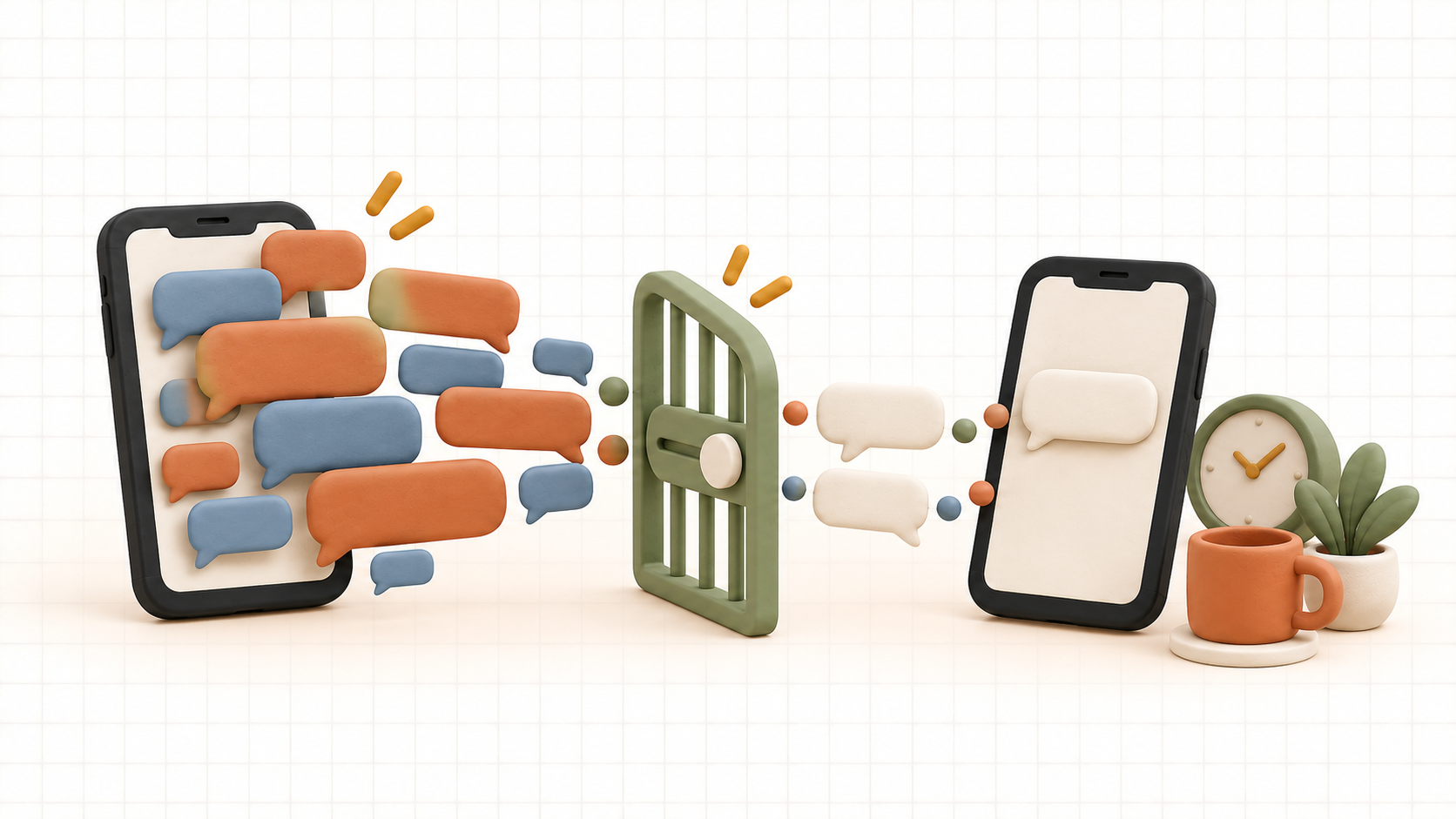
An online friend sends another long message about the same problem. You care about them, but you feel tense when the notification appears. Every conversation becomes a crisis, your own updates disappear, and saying "I cannot talk tonight" fills you with guilt.
Listening is part of friendship. Permanent emotional availability is not. If an online friend always vents to you, a healthy response is not to become colder or solve their life. It is to make support consensual, limited, and mutual enough that the friendship can continue without draining either person.
These ten boundaries address repeated emotional unloading, not a friend mentioning a difficult day. They also avoid diagnosing someone as "toxic" merely because they need support.
Venting, emotional dumping, or a crisis?
The words matter less than the pattern and its impact.
Ordinary venting is usually contained. The person checks whether you have capacity, accepts limits, and remains interested in other parts of the friendship. They may repeat themselves while processing something difficult, but you are allowed to pause.
An unhealthy pattern may involve frequent uninvited monologues, demands for instant reassurance, anger when you are unavailable, the same conversation replacing every other topic, or little room for your experience. The issue is not that their feelings are too much; it is that one friend is being made responsible for holding them without consent.
A possible crisis includes statements about suicide, self-harm, immediate violence, abuse, or being in imminent danger. That needs real-world and professional support rather than ordinary friendship advice. Do not promise secrecy. Encourage local emergency or crisis help, use the platform's safety reporting options, and involve a trusted adult if either person is under 18. The Chats Only Safety Center lists additional resources.
1. Notice the pattern before confronting the person
One exhausting night does not define a friendship. Look across several conversations and identify what is actually happening.
Ask yourself:
- How often does the conversation become heavy?
- Do they ask whether I can listen?
- Can I delay a reply without punishment or panic?
- Do lighter topics and shared activities still exist?
- Does the friend respond when I share something?
- Do they use other supports, or am I treated as the only one?
- How do I feel before and after we talk?
Use observations rather than labels. "Three of our last four calls lasted more than two hours and focused on the same conflict" is easier to discuss than "You emotionally dump on me constantly."
If the friendship is unbalanced in many areas—not only venting—compare the pattern with these one-sided online friendship signs.
2. Ask what they want before doing emotional work
Venting becomes more manageable when the purpose is clear. Ask:
Do you want me to listen, help you think through options, or distract you for a while?
This prevents you from offering an hour of solutions to someone who wants five minutes of acknowledgment. It also reveals requests you cannot meet.
If they say "I just need to vent," you can add a limit:
I can listen for about fifteen minutes, but I do not have capacity for a long conversation tonight.
You are allowed to decide that listening itself is work. "No advice" does not mean "no boundary." A friend can want a witness without being entitled to unlimited access to one.
For ordinary supportive responses, see how to comfort an online friend. That guide explains what to say during a difficult moment; this article addresses what to do when difficult moments have become the relationship's default setting.
3. Require a capacity check before heavy topics
Create a simple habit: ask before sending emotionally intense material. This is especially useful online because the receiver cannot see the subject until the message has arrived.
Before sending a long vent, could you ask whether I have the energy to read it? I care about you, and surprise heavy messages can overwhelm me.
You can agree on a short signal:
Do you have space for something heavy?
I need to vent about work. It is not urgent—when would be okay?
Consent to one conversation is not permanent permission. You can say yes today and no tomorrow. You can also stop after beginning:
I thought I had more capacity, but I need to pause here. I can check back tomorrow.
A healthy friend may feel disappointed, but they will not treat the check as a performance in which only "yes" is acceptable.
4. Put a limit on time, length, or format
Vague limits are hard to use. Choose a boundary you can actually follow.
Examples include:
- Ten or twenty minutes of listening rather than an open-ended call
- One message that summarizes the situation rather than dozens of live updates
- No heavy conversations during work, school, family time, or sleep hours
- Text instead of voice when you need time to process
- Voice instead of a very long text when both people prefer it
- A planned check-in rather than continuous crisis monitoring
Try:
I can stay on the call until 8:30, and then I need to log off even if we have not resolved this.
Long messages are difficult for me to process. Could you send the main point and the question you want help with?
The boundary is about your participation, not controlling how the friend feels. These different texting-style fixes may help when message length and timing add to the strain.
5. Stop accepting urgency that is not an emergency
Some problems feel urgent because emotions are intense, even when no immediate action is required. You do not have to mirror that urgency.
I can tell this matters to you. I am not able to answer tonight, and I will read it tomorrow afternoon.
I cannot help make this decision in real time. Please choose what is safest for you, and we can talk later.
Do not keep notifications on overnight, abandon responsibilities, or repeatedly cancel plans to prove you care. If a friend says every delayed reply is abandonment, acknowledge the feeling without accepting the demand:
I understand that waiting feels difficult. I am still going offline now, and I will not be checking messages until morning.
Actual emergencies need local help. Friendship cannot substitute for emergency services, crisis professionals, medical care, or a trusted person physically nearby.
6. Return responsibility to the person with the problem
Listening can quietly turn into managing: drafting every reply, researching every option, deciding whether they should leave a relationship, or checking that they completed each step.
Ask questions that return choice:
- What do you think your options are?
- What have you already tried?
- Who nearby could help with this?
- What is one step you are willing to take?
- Are you looking for support, or do you want me to decide?
You can care without becoming the project manager.
I have shared the ideas I can think of, and I do not want to keep analyzing this person with you. What you do next is your decision.
Repeating advice more forcefully rarely creates change. If the friend does not want action, you can decline to revisit the same analysis while remaining kind.
7. Protect space for mutual friendship
Venting may be the most visible problem, but the deeper loss is often reciprocity. Ask for room to share ordinary life, humor, interests, and your own difficult days.
I want our friendship to include more than problems. Can we spend part of tonight playing the game and leave the work situation for another day?
I listened yesterday, and I need some space to tell you what has been happening with me. Are you able to listen now?
Notice the response. A friend may need practice shifting attention. That is different from repeatedly redirecting your story back to themselves, dismissing your feelings, or becoming unavailable whenever you need support.
Shared activities can restore a connection that has become all talk. Choose from these things to do with online friends besides texting without using activity as a way to avoid every honest conversation.
8. Encourage more than one source of support
You cannot be someone's friend, counselor, crisis line, family, and entire community at once. Encourage a wider support network without implying that you never want to hear from them.
I care about you, and this is bigger than what I can support alone. Is there someone nearby, a counselor, or another trusted person you can involve?
I can listen sometimes, but I cannot be your only person for this. Who else could be part of your support plan?
Depending on the situation, other support may include family, local friends, a school counselor, employee assistance, a doctor, a therapist, a support group, a crisis service, or a domestic-abuse service.
Do not promise that a specific professional will solve everything. The point is to distribute support appropriately and connect serious needs with people equipped to address them.
9. Follow the boundary instead of debating it repeatedly
A boundary becomes real through your action. If you said you will not answer heavy messages after bedtime, mute the conversation and respond later. If a call ends at a set time, end it.
You do not need a new justification every time:
I am not available for a heavy conversation tonight. We can talk Saturday.
I have answered what I can about this topic, so I am stepping away from it now.
I will not stay in a conversation where I am being insulted for needing a break.
Long explanations can become openings for negotiation. Be warm, brief, and consistent. Our guide to setting boundaries in online friendships includes additional wording for response times, calls, privacy, and conflict.
If the friend creates new accounts, threatens you, or ignores repeated requests to stop, use platform controls and consider ending contact. Boundary violations are not simply a different communication style.
10. Reassess the friendship by their response
The first conversation may be awkward. Judge the pattern afterward.
Healthy adjustment can look like:
- Asking before venting
- Accepting "not now" without retaliation
- Using other sources of support
- Making space for shared interests and your experiences
- Apologizing and changing after overstepping
- Respecting sleep, work, and offline commitments
Concerning responses include guilt, insults, threats, fake emergencies, punishment, repeated boundary testing, or claims that you alone are responsible for their safety.
You may reduce contact, take a break from the friendship, or end it. Their distress does not remove your right to leave. If they threaten self-harm to prevent you from stepping back, take the statement seriously by contacting appropriate crisis or platform support—but do not accept the role of staying forever to keep them safe.
Messages for setting a venting boundary
When you have no capacity
I care about what is happening, but I do not have the emotional capacity to listen tonight. Please reach out to someone else who is available, and I can check in tomorrow.
When you can listen briefly
I have about fifteen minutes and can listen, but I cannot stay for a long call or help make the decision.
When the same issue keeps returning
I know this situation still hurts. We have discussed the same options several times, and I do not have anything new to add. I need us to leave this topic for now.
When every conversation becomes heavy
I value our friendship, and lately most of our conversations have focused on crises. I need more balance—ordinary updates, shared activities, and room for both of us.
When they message during sleep or work
I mute messages while I sleep and work. I will not respond during those hours, so please contact someone local or an appropriate crisis service if you need immediate help.
When you are not qualified to help
This sounds more serious than I can safely support as a friend. I want you to involve a trusted person nearby or a qualified service rather than relying only on me.
When they punish you for saying no
I will not continue a conversation where I am being blamed or insulted for having limits. I am logging off now. We can speak again only if this boundary is respected.
What if your friend says they might hurt themselves?
Treat statements about suicide or self-harm seriously. Ask directly whether they are in immediate danger and encourage them to contact local emergency services or a crisis service where they live. If you know a trusted person near them and believe danger is imminent, contact that person. Use the platform's suicide or self-harm reporting process when available.
Do not promise secrecy, attempt to provide therapy, or agree to remain online indefinitely as the only safety plan. The 988 Lifeline's social-media guidance explains how platforms and community members can respond to suicidal content; people outside the United States should use appropriate local crisis resources.
If you are under 18, involve a trusted adult immediately. You should not carry another person's crisis alone.
Frequently asked questions
Is venting to a friend unhealthy?
Not inherently. Venting can help someone feel heard and organize their thoughts. It becomes a problem when it is nonconsensual, constant, coercive, or replaces mutual friendship and appropriate support.
Am I selfish for not wanting to listen?
No. Capacity changes, and listening can require real energy. You can care about a friend while being unavailable for a topic or conversation.
Should I call it emotional dumping?
Usually, describing the behavior is more productive than assigning a label. Explain the timing, volume, frequency, and effect on you, then make a concrete request.
What if they have nobody else?
That can be painful and still does not make one friend a complete support system. Encourage additional trusted people and qualified services while keeping only the level of contact you can safely sustain.
Should I stop giving advice?
If your advice is repeatedly requested but never used, ask what they want from the conversation. You can listen briefly without problem-solving or decline to revisit the same decision.
Can the friendship recover?
Yes, if both people can discuss the pattern and change it. Clear capacity checks, time limits, more mutual conversation, and additional support can make the friendship feel like a friendship again.
Support works better when it has limits
A caring friend listens sometimes. A healthy friendship also allows delayed replies, lighter conversations, separate lives, and a genuine no.
Name the pattern without shaming the person. Ask what they need, state what you can offer, and follow the limit consistently. You are not abandoning someone by refusing to become their only place for every difficult feeling. You are protecting the conditions that make sustainable support—and friendship—possible.