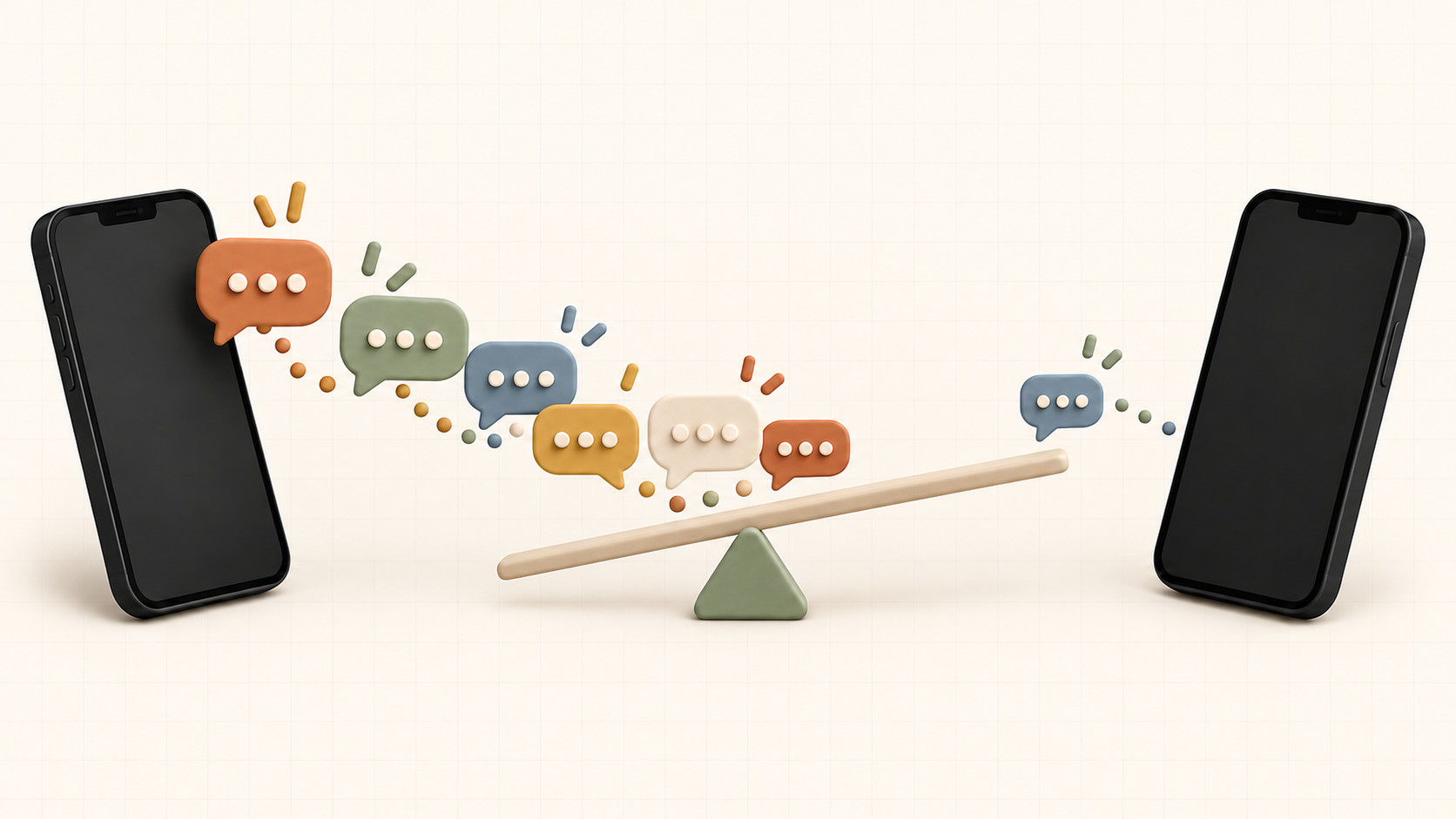
You send the first message, ask the follow-up questions, remember important dates, and keep the conversation alive. Your online friend replies sometimes, but you are beginning to wonder whether the friendship would exist if you stopped doing all the work.
A one-sided online friendship is not defined by one slow week or an uneven conversation. Friendships naturally shift when someone is busy, ill, grieving, overwhelmed, or dealing with a major change. The concern is a lasting pattern in which one person provides most of the attention, support, flexibility, and effort while the other mainly receives it.
These 10 signs can help you evaluate the pattern without turning response times into a scorecard.
What Reciprocity Looks Like Online
Reciprocity does not mean equal message lengths, identical schedules, or taking turns with mathematical precision. Two friends may show care differently. One initiates more often; the other remembers details, makes time for calls, shares useful recommendations, or shows up reliably when it matters.
A reciprocal online friendship usually gives both people some experience of being:
- Contacted without always asking first
- Listened to as well as heard
- Remembered outside moments of need
- Included in plans and decisions
- Free to say no or be unavailable
- Supported in ways that fit each person's capacity
- Valued for who they are, not only for what they provide
Look for movement in both directions over time, not identical behavior in every exchange.
1. You Always Start the Conversation
Some people rarely initiate messages but respond with warmth and attention. That alone does not make a friendship one-sided.
The stronger sign is a combination: you always reach out, their responses are minimal or inconsistent, and they make no other effort to reconnect. When you stop initiating, the friendship disappears until they want something.
Before drawing a conclusion, consider whether you ever discussed communication preferences. A friend may assume you enjoy initiating, worry about interrupting, or be much more comfortable with scheduled conversations than spontaneous messages.
2. They Reply but Show Little Curiosity About You
The chat may continue, yet every topic eventually returns to their life. They answer your questions without asking any, skip past your updates, or use your experience as a bridge back to their own story.
One distracted conversation happens to everyone. A repeating lack of curiosity can make you feel like an audience rather than a friend.
Healthy listening can be learned. You can model it and name what you need, but you cannot create mutual interest on another person's behalf. Our guide to being a better listener online provides a useful comparison point.
3. They Contact You Mainly When They Need Something
Their messages arrive when they need advice, reassurance, money, a favor, help with a project, or someone to absorb a crisis. Once the need is met, they become unavailable again.
Friendship includes helping each other, and difficult seasons can temporarily make support uneven. The pattern becomes concerning when ordinary interest is absent and your role is consistently limited to solving problems.
Be especially cautious when requests involve money, account access, secret-keeping, or escalating emergencies. Review online friendship red flags when imbalance is combined with pressure, threats, deception, or exploitation.
4. Emotional Support Flows Only One Way
You stay through their long voice notes, difficult nights, and repeated problems. When you need support, they change the subject, disappear, become impatient, or say you are too demanding.
No friend can be available for every conversation. A caring limit sounds like:
I want to hear this, but I do not have the energy tonight. Can we talk tomorrow?
A one-sided pattern looks different: your emotions are repeatedly treated as an inconvenience while theirs are presented as your responsibility.
5. Plans Happen Only on Their Terms
You always adapt to their time zone, preferred game, chosen platform, or last-minute availability. Your ideas are ignored, and they become annoyed when you cannot adjust.
Different schedules may require one person to be more flexible. Reciprocity appears in the effort to account for both people, even when the final arrangement cannot be perfectly equal.
Try suggesting one specific alternative. Their response can tell you more than whether the original plan worked:
That time is difficult for me. I can do Saturday morning or Sunday evening. Would either work for you?
6. Their Promises Rarely Become Actions
They often say, "We should talk soon," "I will check that out," or "I will be there," but rarely follow through. When plans fail, you are left to restart the conversation and arrange everything again.
People forget and circumstances change. Look for whether they acknowledge it, communicate, and make a realistic new effort. Repeated enthusiasm without action can keep you invested in a friendship that exists mainly as a future promise.
7. Your Boundaries Matter Only When Convenient
They expect you to respect their quiet time, sensitive topics, and preferred pace. Your limits are debated, mocked, or repeatedly tested.
Examples include:
- Calling after you asked them to message first
- Pressuring you to share photos or personal details
- Becoming angry when you cannot respond immediately
- Continuing a topic after you asked to stop
- Expecting secrecy you did not agree to
- Treating your other friendships as competition
A boundary is not one-sided because the friend dislikes it. The problem is a pattern in which only one person's comfort is allowed to shape the relationship. Use these online friendship boundary scripts to state a limit clearly.
8. You Are Constantly Managing Their Reactions
Before sending an ordinary message, you rehearse it repeatedly. You soften every disagreement, hide positive news, or avoid mentioning other friends because you expect guilt, jealousy, withdrawal, or anger.
Thoughtfulness is healthy; chronic emotional management is exhausting. You should not have to make yourself smaller to keep basic peace.
If you fear retaliation, threats, stalking, exposure of private material, or attempts to evade blocks, prioritize safety over a relationship discussion. Save relevant evidence, use block and report tools, and review the Chats Only Safety Center.
9. You Feel Drained More Often Than Connected
Every friendship has difficult conversations. Pay attention to the overall effect.
After most interactions, do you feel appreciated and connected, or responsible, anxious, and depleted? Do you enjoy talking with this person, or mainly feel relief when they are satisfied?
Your feeling is information, not automatic proof that the other person is bad. Use it to examine the pattern and identify what needs to change.
10. The Imbalance Continues After You Address It
The clearest sign is not that a problem exists. It is what happens when you raise it respectfully.
A friend who values the relationship may be surprised or defensive at first, but they become curious, explain what has been happening, and try a realistic change. Improvement may be imperfect, especially when capacity is limited, but some mutual effort becomes visible.
A one-sided dynamic is more likely when they dismiss your experience, promise change only to end the discussion, punish you for speaking, or insist that every adjustment must still come from you.
What Can Look One-Sided but May Not Be
Before deciding, consider explanations that do not depend on assuming bad intent:
- A temporary crisis, illness, loss, or demanding schedule
- Different time zones and daily routines
- Different communication styles or comfort with initiation
- Limited social energy or difficulty switching between tasks
- An unspoken assumption about who usually makes plans
- A shift from frequent contact to a lower-maintenance friendship
- A platform problem, muted notification, or lost account access
An explanation can add context without erasing the impact. "I am overwhelmed" may explain why someone cannot offer much right now. You can care about that reality and still decide you cannot keep carrying the friendship alone.
Review the Pattern Fairly
When you feel hurt, the most recent message can make the entire friendship seem different. A short review helps you focus on patterns rather than one moment.
Look back over the last several weeks or a period appropriate to your usual pace. Ask:
- Who initiated conversations, calls, or activities?
- When I shared something important, how did they respond?
- Did they remember or follow up later?
- Could both people decline plans without punishment?
- Were favors and support moving in both directions?
- Did I clearly communicate what I needed?
- Has the pattern changed recently, or has it always been this way?
Do not secretly count every message or create a test the other person does not know they are taking. The review is for clarity, not evidence for a prosecution.
If your main concern is a recent unexplained silence rather than an ongoing imbalance, read what to do when an online friend stops replying.
How to Talk About a One-Sided Online Friendship
Choose a calm moment. Describe specific behavior, explain its effect, and ask for one realistic change.
Use this formula:
What I have noticed + how it affects me + what I need + an open question
For example:
I have noticed that I usually start our conversations and make our plans. Lately I have felt unsure whether you still want this friendship. I need the effort to feel more mutual. How does the friendship feel from your side?
Or:
I care about you, but most of our conversations have focused on crises in your life. When I try to share, we often move past it. Could we make more room for both of us?
Keep the conversation about the pattern you experience. Labels such as "selfish," "toxic," or "bad friend" make it easier to argue about character and harder to discuss behavior.
What Their Response Can Tell You
They Listen and Make a Concrete Change
Give the friendship room to adjust. A useful change is specific: they initiate once a week, ask before venting, respond to your important updates, or share responsibility for plans.
Notice actions over time rather than demanding instant perfection.
They Explain That Their Capacity Has Changed
Discuss what is realistically available. Maybe the friendship moves from daily messages to a monthly call or from long conversations to sharing occasional recommendations.
A smaller friendship can still be genuine when both people agree on its shape.
They Disagree With Your View
Listen for information you may have missed. Perhaps they believe they show care in a different way or have felt excluded themselves. You do not have to abandon your experience, but the conversation may reveal a solvable mismatch.
They Dismiss, Mock, or Punish You
You do not need to keep proving that your needs are legitimate. End the discussion, protect your boundaries, and decide what access the relationship should have.
How to Step Back Without Playing Games
Stepping back is not a test designed to make someone panic. It means investing at a level that is sustainable for you.
You might:
- Stop being available for every crisis
- Decline favors you do not want to provide
- Let some conversations end naturally
- Offer plans that also work for your schedule
- Spend more time in reciprocal friendships and communities
- Mute notifications when constant urgency affects you
- Change the friendship from close to casual
You can be direct:
I care about you, but I cannot continue being available in the same way. I am going to step back from frequent conversations.
Do not delay replies solely to create anxiety, post indirect messages, or recruit mutual friends to take sides. Those tactics reproduce the unhealthy dynamic instead of clarifying it.
When to End the Friendship
Ending may be appropriate when the imbalance remains harmful after clear communication, your boundaries are repeatedly ignored, or the friendship depends on fear, manipulation, financial requests, or unwanted contact.
You can write:
This friendship is no longer working for me, so I am ending contact. I wish you well and ask that you respect my decision.
You may block without a final conversation when contact is threatening, exploitative, harassing, or unsafe. You do not owe further access in order to appear polite.
For a relationship that is not unsafe but needs a courteous close, adapt one of these ways to end an online conversation politely to fit the larger friendship.
Do Not Blame Yourself for Carrying It
People stay in one-sided friendships for understandable reasons: affection, history, hope, loneliness, loyalty, or memories of a more balanced period. Your effort was not foolish simply because it was not matched.
The useful question is not "How did I let this happen?" It is:
What level of effort is healthy for me now?
You can appreciate what the friendship meant and still stop sustaining it alone.
Frequently Asked Questions
How do I know if an online friendship is one-sided?
Look for a repeated combination of unequal initiation, limited curiosity about you, support flowing one way, plans happening only on their terms, and little change after you communicate. One slow or difficult period is not enough by itself.
Is it one-sided if I always text first?
Not necessarily. Some friends rarely initiate but respond thoughtfully, remember details, and show care in other ways. It becomes more concerning when you initiate everything and receive little engagement or effort in return.
Should I stop messaging to see if they notice?
It is fine to stop overextending yourself, but avoid using silence as a secret loyalty test. If the friendship matters and it feels safe, explain what you have noticed and what you need.
Can a one-sided friendship become balanced?
Yes, when the imbalance comes from an unspoken expectation, temporary circumstance, or communication mismatch and both people are willing to adjust. Promises matter less than consistent changes in behavior.
How long should I wait for the friendship to improve?
There is no universal deadline. Choose a period that fits your normal communication rhythm and the change requested. Look for some visible mutual effort rather than waiting indefinitely for a complete transformation.
Am I selfish for wanting more effort?
No. Wanting curiosity, consideration, and mutual support is reasonable. Your friend may not have the capacity to offer them, but you are still allowed to choose relationships that meet your needs.
What if my online friend is going through a crisis?
Offer only the support you can genuinely sustain, encourage appropriate offline or professional help when needed, and keep your own limits. A crisis can explain temporary imbalance without making you solely responsible for the person's safety or well-being.
Is a one-sided friendship the same as a toxic friendship?
No. Imbalance can come from habit, mismatched expectations, or limited capacity without deliberate harm. Threats, coercion, manipulation, financial exploitation, or repeated boundary violations raise separate safety concerns.
A one-sided online friendship becomes clearer when you stop measuring isolated replies and examine the whole pattern. Ask for what you need, watch what happens next, and invest your energy where care can travel in both directions.